


2.1 Patient-informed endpoints
Successful digital endpoint development is grounded in the patient perspective.
This section will help you identify meaningful aspects of health (MAHs) that translate into measurable concepts of interest (COIs), to define endpoints that are both clinically relevant and digitally measurable for your clinical trial.
Your sDHT strategy begins with the people it’s meant to serve: the patients whose lives you’re aiming to improve through better measurements and treatments. Patient-informed digital endpoints serve as the compass that keeps your work grounded in what truly matters. We build these endpoints by starting with direct input from patients, ensuring that the data you collect reflects real improvements in how they feel, function, or survive day to day. This approach transforms abstract clinical goals into tangible outcomes that resonate with everyone involved, from trial participants to regulators.

Measures that matter
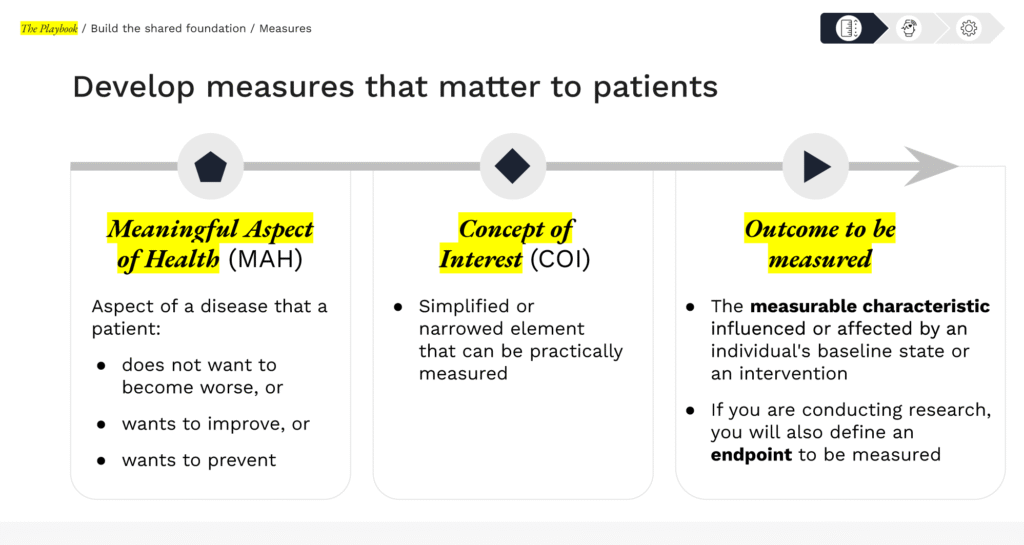
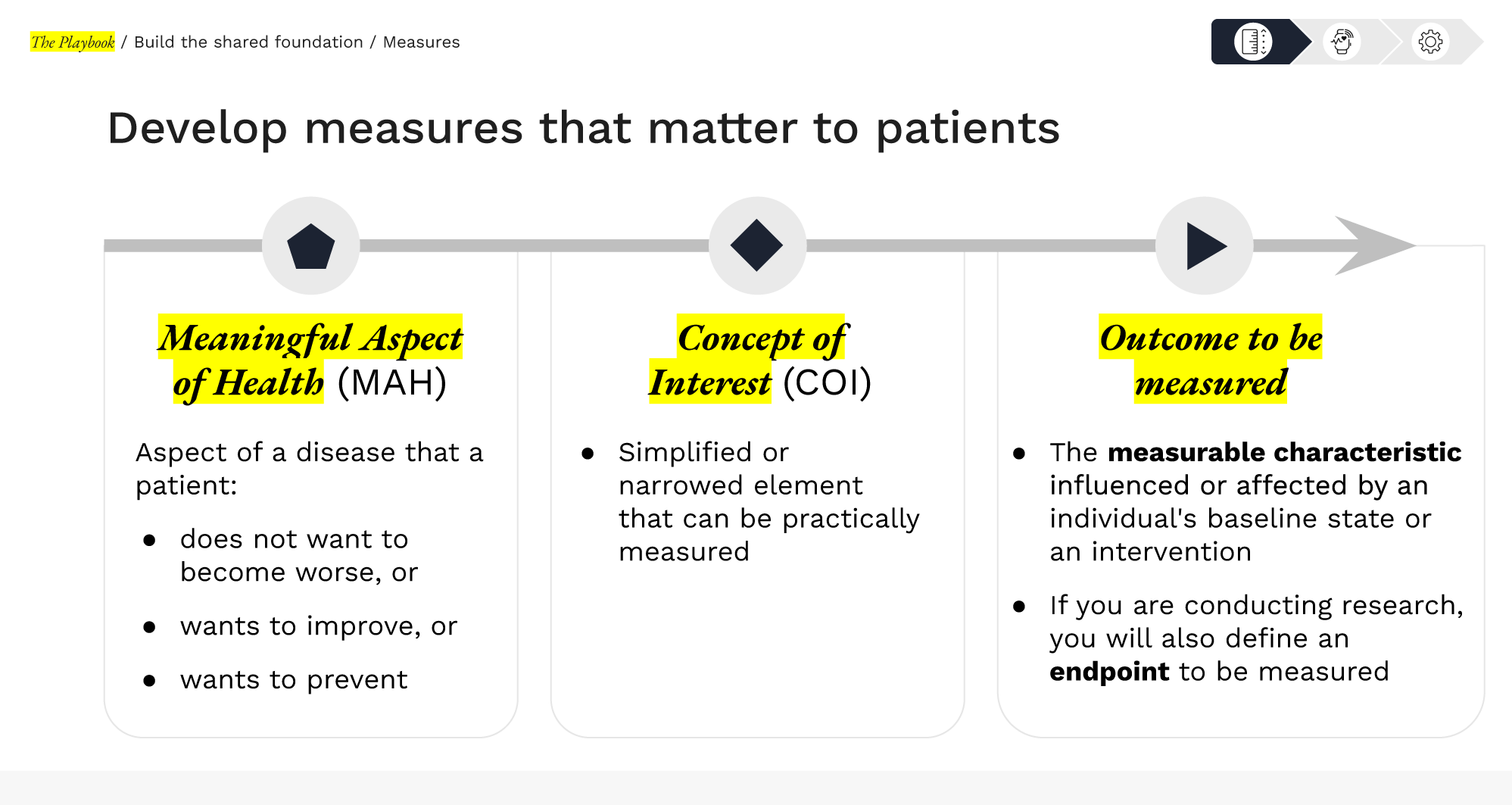
This flow, MAH to COI to endpoint, is from the Measures that Matter framework, as captured in The Playbook: Digital Clinical Measures.
Learn how this framework helps you deploy digital measures

FDA SPOTLIGHT
These terms are now reflected in FDA guidance as well. “Clinical benefit is defined as “a positive effect on how an individual feels, functions, or survives”. To provide clinical benefit, a medical product should affect a meaningful aspect of health (MAH), i.e., some aspect of feeling or functioning in daily life that is important to patients … In a clinical trial, we study the effect of a medical product on a MAH by estimating a treatment effect on an endpoint that is thought to reflect the MAH.
To precisely describe the role of a COA in a clinical study, sponsors should propose to FDA how they intend to interpret scores from a COA (i.e., what they believe the score measures), how scores will be used to reflect the MAH (e.g., to construct an endpoint), and the context in which scores will be used. In other words, the sponsor’s proposal should explicitly reference the MAH, the concept of interest (COI; see section II.B.2) and the context of use (COU; see section II.B.3).”
– Section II.B The Role of COAs in Evaluating Clinical Benefit for a Medical Product, p. 7

OVERVIEW
A foundational step
Traditional endpoints in trials often rely on clinician observations or standardized tests conducted in controlled settings, which can miss the nuances of a patient’s everyday experience. sDHTs open up a world of possibility here, allowing for continuous, real-world data capture that aligns closely with patient priorities.
To make digital measurement meaningful, start by identifying Meaningful Aspects of Health (MAHs), or the elements of health that patients identify as most important, such as reducing fatigue, enhancing mobility, or preserving independence. These priorities can then be translated into Concepts of Interest (COIs), which are specific, measurable expressions of the MAH that an sDHT may be capable of capturing, such as step variability as a proxy for balance in Parkinson’s disease or sleep patterns in mood disorders.

As an adopter, this means prioritizing patient voices from the outset of your trial design, collaborating with advocates or using established frameworks to gather insights without overwhelming anyone.

Developers, your role shines in helping map those COIs to what your technology can reliably measure, ensuring the endpoint is feasible while staying true to patient needs.
FDA SPOTLIGHT
Increasingly, regulators and payors expect that endpoints reflect outcomes that genuinely matter to patients. The FDA’s Patient-Focused Drug Development (PFDD) Guidance Series emphasizes that endpoints should demonstrate clear links to patient experiences, making your submissions stronger and more approvable (see Regulatory spotlight below). This patient-first mindset boosts trial relevance and enhances recruitment, retention, and overall impact, turning data into stories of genuine progress.
Patient meaningfulness is of course not an isolated datapoint; it should be interpreted in the context of the trial’s scientific objectives and the expected treatment effect. Endpoints are most compelling when the aspect of health that matters to patients is clearly linked to how the medical product is intended to work and to the type of clinical benefit the trial is designed to demonstrate.
IN PRACTICE
Getting this right
Begin by assembling a diverse group of patients and caregivers to discuss their challenges and hopes—tools like patient engagement best practices (see Industry spotlight below) can guide these conversations to be respectful and productive. From there, refine your MAHs into COIs. If you’re unsure where to start, look for inspiration in the collaborative models linked in the Industry spotlight below. This is an iterative process that builds trust and refines your strategy as you go.
Early alignment with patient priorities helps you:

Reduce regulatory uncertainty
Endpoints lacking robust evidence of patient-centeredness such as direct patient input, advocacy group insights, or validated research demonstrating relevance to patient priorities may be less likely to be accepted by FDA.
Gather this evidence through direct patient engagement (e.g., interviews, surveys), insights from advocacy groups, literature reviews, or precompetitive consortia outputs.
FDA SPOTLIGHT
The FDA’s Patient-Focused Drug Development (PFDD) series of guidances “is intended to facilitate the advancement and use of systematic approaches to collect and use robust and meaningful patient and caregiver input that can better inform medical product development and regulatory decision making.”
Aspects of health that are important to patients must be identified through direct, representative patient input. By grounding clinical outcome assessments in what matters most to patients, adopters increase the likelihood that selected endpoints will be considered relevant, interpretable, and acceptable for regulatory decision-making.
Accelerate go/no-go decisions
Early patient-focused insights provide a reality check on whether a proposed digital measure or endpoint is viable from a commercial perspective. Teams can confidently pursue, refine, or pivot away from a digital measure before investing significant resources, saving time and budget.
Strengthen competitive advantage
Companies known for meaningful patient engagement may earn trust and loyalty from adopters, patient communities, advocacy groups, and healthcare providers, driving adoption and brand reputation.
Patient engagement best practices
Identifying meaningful aspects of health requires structured, representative, and sustained engagement.
Best practices from across the field support adopters and developers in conducting patient engagement that is methodologically sound and ethically grounded.
You can be successful in patient engagement when you:
- Initiate engagement early to inform endpoint selection and trial design
- Include representative voices across age, race, geography, disease severity, and lived experience
- Clearly define roles, expectations, and contribution pathways for all participants
- Establish trust and transparency through regular communication and follow-through
- Leverage the unique capabilities of patient groups, including registries, community outreach platforms, and lived expertise
- Treat patient and advocacy partners as essential collaborators across the development lifecycle.
KEY TAKEAWAYS
What good looks like
Identify the MAH
Identify patient priorities, or meaningful aspects of health (MAH)
Identify the COI
A measurable aspect of an individual’s clinical, biological, physical, or functional state that reflects the MAH (e.g., gait speed, sleep efficiency, number of anxiety episodes).*
Assess feasibility
Evaluate whether the COI can be captured using an sDHT and identify digital endpoints for that COI that reflect patient priorities and are technically and operationally feasible.
*For example, a patient-prioritized concern such as “uninterrupted sleep” may be represented by a COI like “frequency of night wakings.” The COI is the specific, measurable expression of that priority and serves as the foundation for endpoint selection.

Transforming what matters to what can be measured
While the specific details will vary by disease area and trial objective, the progression from Meaningful Aspects of Health (MAHs) to Concepts of Interest (COIs) to candidate endpoints typically follows a structured logic.
An MAH reflects an aspect of health that patients identify as important in daily life, such as uninterrupted sleep, maintaining independence, the ability to move safely, or getting through the day without overwhelming fatigue.
These priorities are translated into COIs, which are specific, observable aspects of functioning or experience that reflect the MAH and may be measurable, such as frequency of night wakings, gait stability, duration of sustained activity, or variability in daily movement patterns.
Candidate endpoints are then defined as measurable expressions of one or more COIs that could be assessed in a clinical trial, pending specification of context of use, such as number of wake events during the primary sleep period, distributions of walking speed, or changes in daily active time over a defined window.
At this stage, the objective is not to finalize endpoint definitions, but to ensure that candidate measures remain clearly traceable to patient priorities and plausible for further refinement using digital technologies.
By the end of this section, you should have a preliminary shortlist of candidate digital endpoints that are grounded in aspects of health meaningful to patients and articulated at the level of Concepts of Interest. These candidates will be further refined, evaluated, and specified as discussed in Section 2.2: Context of use.
2.1 Patient-informed endpoints
Library resources to guide you
The sDHT roadmap library gathers 200+ external resources to support the adoption of sensor-based digital health technologies. To help you apply the concepts in this section, we’ve curated specific spotlights that provide direct access to critical guidance and real-world examples, helping you move from strategy to implementation.
Features essential guidance, publications, and communications from regulatory bodies relevant to this section. Use these resources to inform your regulatory strategy and ensure compliance.
Gathers real-world examples, case studies, best practices, and lessons learned from peers and leaders in the field relevant to this section. Use these insights to accelerate your work and avoid common pitfalls.